
Objectives
Objective 1. To appreciate how Patita Pavana symbolizes Lord Jagannath’s universal mercy, welcoming all souls irrespective of caste, creed, or social status and location.
Objective 2. To identify the unique features of the Patita Pavana deity in comparison with the main Jagannath triad.
Objective 3. To explore the sequence of morning rituals, including the opening of the Patita Pavana shrine, Mailama, and Abakasha.
Objective 4. To understand the tradition of offering Bhoga to Patita Pavana Jagannath along with the main deities of the temple.
Objective 1. To appreciate how Patita Pavana symbolizes Lord Jagannath’s universal mercy, welcoming all souls irrespective of caste, creed, or social status and location.
Patita Pavana Jagannath
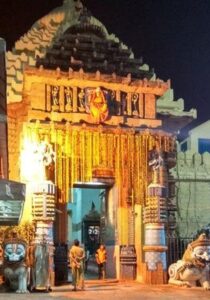
Patita Pavana (meaning “Purifier of the Fallen”) is a representation of Lord Jagannath located at the Lion Gate (Singhadwara) of the Jagannath Temple in Puri.
It allows devotees who are traditionally not permitted inside the main temple to receive darshan (sacred viewing) of the Lord directly from the street.
The name combines Patita (fallen/sinner) and Pavana (purifier/saviour). Historically, when certain sections of society were barred from entering the main temple complex, they found solace in praying to this deity located at the base of the eastern entrance.
The iconic flag hoisted daily at the top of the grand temple, known as the Patitapabana Bana, also signifies the Lord’s universal grace and invitation to all souls to seek refuge.
The manifestation of Patita Pavana is often tied to the history of King Ramachandra Dev II in the 18th century, and the beloved devotee Salabeg, who was born into a Muslim family and unable to enter the sanctum sanctorum.
The main temple management enforces strict regulations on non-Hindus, making the Patita Pavana murti (deity) the primary option for interfaith devotees to view the Lord.
Early morning Mangal Arati is held daily, offering a serene experience for the devotees who are not permitted inside the temple.
Deity’s Special Features:
Objective 2. To identify the unique features of the Patita Pavana deity in comparison with the main Jagannath triad.
Deity’s Special Features:
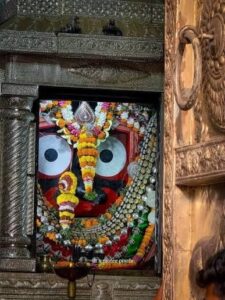
Unlike the main shrine where Lord Jagannath is worshipped as a triad alongside his brother Balabhadra and sister Subhadra, Patita Pavana stands completely alone.
The Patita Pavana murti manifests solely as a face, entirely lacking the jutting stump-arms, legs, or torso seen on the main Jagannath.
The deity is depicted without the Sudarshana Chakra, which always accompanies the triad inside the main temple.
In Odia culture, when Lord Jagannath is worshipped independently in this form, he is also referred to as Dadhi Vaman.
The ultimate uniqueness lies in its positioning; it faces the Grand Road (Bada Danda) through the main door, ensuring anyone can catch his glance without passing the temple thresholds.
Objective 3. To explore the sequence of morning rituals, including the opening of the Patita Pavana shrine, Mailama, and Abakasha.
The Ritual:
Early in the morning (usually between 4:00 AM and 5:00 AM), a designated servitor known as the Bhitarchha Mohapatra arrives to open the main Lion Gate.
He breaks the previous night’s seals, performs a brief worship to the gate, and opens the heavy doors. Immediately following this, the specific doors protecting the Patita Pavana shrine on the right wall are unlocked.
The deity’s clothes from the previous night (Mailama) are changed. The priest performs a symbolic tooth-brushing and bathing ritual (Abakasha) using a mirror to reflect water, followed by dressing the deity in fresh morning attire.
Objective 4. To understand the tradition of offering Bhoga to Patita Pavana Jagannath along with the main deities of the temple.
Bhoga Offering:
Whenever major food offerings (Bhoga) are offered to the main deities inside the sanctum, a portion or a dedicated simpler offering is presented to Patita Pavana.
Devotees regularly buy Maha Prasad or smaller dry sweets from the local vendors to offer directly to Patita Pavana through the duty priest at the gate.
